On Milkweed
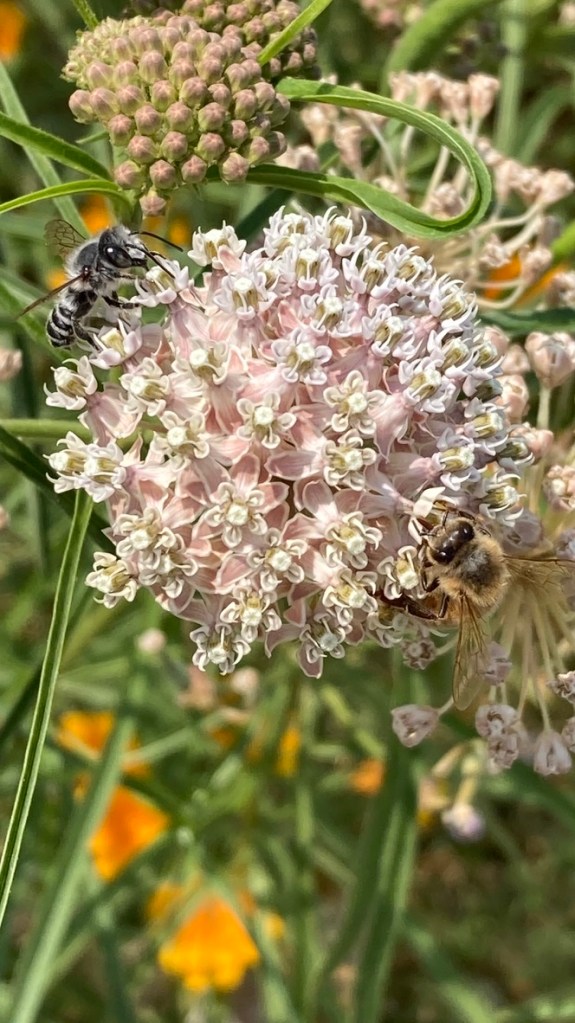
Back in 2021, I ordered a packet of Asclepias fascicularis (narrow-leaf milkweed) from Nicholas Hummingbird, an indigenous seed seller and educator from SoCal. I wasn’t sure if seed of that provenance would tolerate Portland’s freezes, but I overwintered a flat of his seeds outside, they germinated, and I planted them. By mid-summer they were producing some of the most entrancing blooms I’ve had the privilege to know.
Since then, milkweed has become my favorite plant companion and biggest source of garden joy. I stand in wonder by my milkweed patch, most days. Yes, because the flowers are beautiful, the plant long-blooming, and the cottony fruits/seeds delightful, but truly because it is magically attractive to life. It draws many species of bumblebees, mason bees, honey bees, wasps, flies, spiders, moths, crickets, beetles and butterflies— all creatures I knew little or nothing about until they started showing up and partying in my milkweed patch, sending me to entymology Facebook groups to ID them, and causing me to wonder where all this life had been hiding in Portland. Daily there is gratitude, drama, and excitement in my milkweed patch. The milkweed conjured what I couldn’t have imagined.
I love this plant, too, because of how resilient and defiant it is. I treat my garden as an experiment in cultivated-neglect—because of limited time and resources, and because I want to see what is likely to survive under hands-off conditions—which can definitely produce some disappointing results. But this plant thrives here. Some summers I irrigate once a week, some even less so. Either way it returns happily, and two-fold: less watering just means earlier seeding. More watering means more flowers. If I weed the patch, it grows. If I don’t, it grows. if I dead-head, it opens more seed pods the next day. If I cut below the flowers, it will make more. Honestly this plant is a little bit of a beloved pest. Yeah: it’s a weed.
I’m sure with all this talk of weediness I haven’t sold anyone on this plant, except maybe the plant-nerdiest among you. But I’m sharing this because narrow-leaf milkwood has taught me a different way of seeing the gardens we cultivate, and changed the aesthetics I most appreciate and seek out in gardens. I’m more willing to let things look messy over winter, keeping the hollow stems of the milkweed intact rather than cutting them to the ground, in case any insects want to make home there. I do let the blossoms wilt and turn to seedpods. I plant native annuals to fill the space in spring and early summer, which themselves are visited gratefully by many lifeforms. I let the plant age and get ugly and dried out and show me how it looks when it’s decaying, and in return I collect the seeds and give them away or guerilla garden with them, and witness with grief/joy the changing of the seasons in the cycles of this plant. And I do all this because I figured out that supporting somewhat unbridled life brings me so much more joy than a sense of order or control— a lesson for other parts of my life.
On the meaning of Jubilee
It’s aspirational.
In Torah, Jews are instructed to practice shmita (“release”) every seventh year. For shmita, all debts are forgiven. The lands we work lay fallow to rest, and we eat only from what is freely offered (fruit-bearing trees, perennials, self-seeded annuals, wild plants). All are welcome to harvest from everywhere. And after every seven shmitas is the grand sabbath of sabbatical years: Jubilee. On this year, slaves are freed, lands returned to their original owners, all debts once again expunged, all families to reunite and rest on land. Jubilee is a big beautiful reset button, a course correction for the mis-steps we’ve inevitably and humanly made out of greed, fear, short-sightedness, compliance.
You’ve probably guessed that this cyclical practice isn’t observed in most forms of Judaism today. In fact, throughout millenia of Jewish cultures, people apparently struggled and failed to practice this for the most part. I can understand why. Jubilee is such a radical and subversive idea, so challenging to hierarchical power, which rarely cedes an inch. Jubilee (and shmita) challenge some dominant and fundamental assumptions about productivity, property rights, land ownership, and control over earth and each other. And Jubilee doesn’t demand control. It demands deep relationality, cooperation, care, rest and trust— in each other and the earth.
With the Jubilee cycle, we test and see: how ready were we able to get, how much closer to liberation were we able to move, in that time span of 6 or 49 years? Did we prepare well enough to meet the demands of the cycle, to release? To be free together, at least for a little while?
As with all Jewish historical writings, or any belief system, we need to actively assess and square the concept of Jubilee with our values before taking it into practice (for example, Zionist interests claim and twist it for their own).
But I claim Jubilee as deeply radical inspiration and aspiration for my gardening and my relationship to land, a horizon line to keep moving toward. I transitioned from teaching high school to gardening because I wanted to connect with the earth every day, get to know it more, and how I am in it. I was inspired by the coast live oaks and the creek in my backyard in Oakland, learning about the birds that made those trees home. After a short while working for landscape contracting companies, while taking horticulture courses, I started to see the landscape in a new way— to see the many layers of destruction that have happened to our landscapes, and the work it will take to heal our relationships to place and land. I know we all hold grief about land, but the more you learn about plants, soil, animals, and history of colonization, the more there is to witness, and the more there is to grieve and to love and to hope for.
Jubilee is about all that. When I garden I aim to always keep an eye on the horizon behind and ahead of us. Gardening is mundane, it’s really not grandiose on the day to day. This might all sound silly, to say my business is about these grand ideas when really what I do most days is weed, dead-head, prune shrubs— a lot of it in pretty inert gardens dominated by non-native plants. But in the moments when I can make grounded recommendations about how to support habitat in the coming season, even with small changes, and it takes a little bravery to suggest something new to a client, it helps to think about the horizon: Jubilee.
follow me on Instagram for more musings:
@jubileegardens.lovesyou
 Jubilee Gardens